


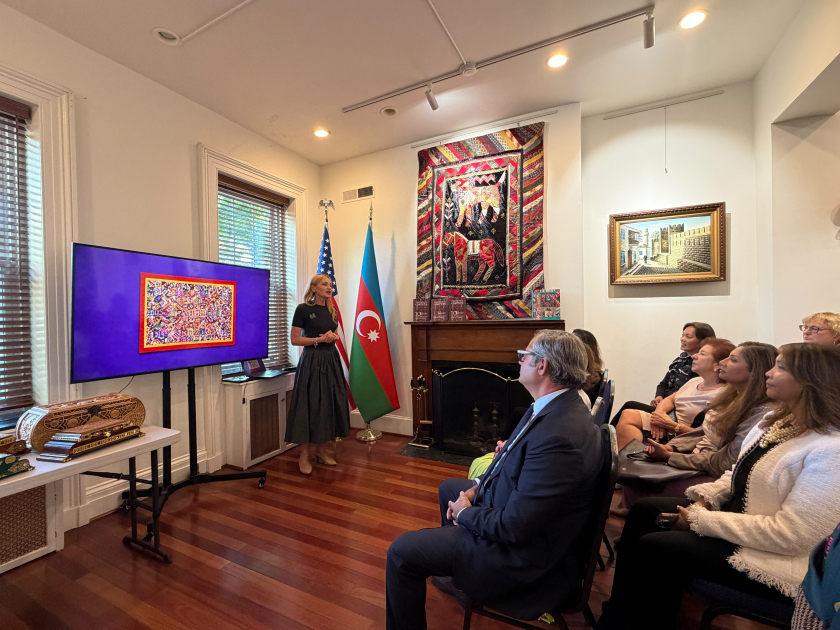
A presentation titled “Azerbaijani Culture Day: Patterns, Colors and Stories,” dedicated to Azerbaijan’s carpet-weaving art, gurama patchwork traditions, and national handicrafts, was held in Washington, D.C., the capital of the United States.
The event was jointly organized by the Embassy of Azerbaijan in the United States and the U.S.-Azerbaijan Chamber of Commerce. Participants included representatives of cultural and arts organizations, including the George Washington University Museum and The Textile Museum, Cultural Exchange for Diplomats, and Welcome to Washington International Club.
Addressing the event, Natig Bakhishov, Executive Director of the U.S.-Azerbaijan Chamber of Commerce, highlighted the role of culture in strengthening mutual understanding and economic ties, noting that it adds a human dimension to business cooperation.
Azerbaijan’s Ambassador to the United States, Khazar Ibrahim, emphasized that art supports cultural preservation and emotional well-being. He noted that Azerbaijani carpets and traditional crafts are essential to national identity, preserving family bonds, collective memory, and spiritual values across generations.
In her remarks, Amina Malikova, Director of the Azerbaijan National Carpet Museum, presented the English edition of “Happiness in Carpets: 10 Reasons Why Carpets Make People Happy,” highlighting the cultural and spiritual significance of Azerbaijani carpets and their role in preserving national heritage. She noted that the museum houses approximately 12,000 carpets and related items.
Amina Malikova also presented the exhibition “Gurama: Stories Woven from Ties,” featuring artworks created from around 5,000 used ties collected from various countries.
The newly unveiled artworks feature Karabakh carpet motifs, a portrait of Azerbaijani poet Imadaddin Nasimi, and themes related to Azerbaijan’s oil industry and cultural heritage. The project aims to give new life to unused objects while preserving their historical and spiritual value.
At the event, Lala Sardarli, a representative of the Public Association for the Preservation and Promotion of Applied Arts, also presented the “Art Therapy: Safeguarding Culture and Health” project, describing how a family handicraft initiative evolved into the study and promotion of traditional Azerbaijani chest- and casket-making.
She noted that the Sandigchilig cultural and creative space in Novkhani, Baku, established during the pandemic, now hosts research, exhibitions, workshops, and cultural events.
Handcrafted works showcasing Azerbaijan’s cultural heritage and creativity were exhibited at the event. Guests also learned about the history and cultural significance of traditional Azerbaijani silk kelaghayi headscarves.